

Z1-06-Leadership – Competence AND Character
DOWNLOAD MODULE: 21st Century Leaders: Competence And Character
21st Century Leaders:
Competence AND Character
One has to ask oneself, what do you say to the leaders of the twenty first century, because that’s what you are.
You are America’s leaders of the twenty first century.
I’m nearing the twilight of a mediocre career in a few short months.
I’m gone, because that’s the only way it works. We can’t have a top clogged and blocked by a few, restricting the upward movement of many, many other exceptional young leaders that are out there.
I thought about this a lot but fundamentally it turns out that you no different than I, and therefore I think that some of the lessons that I have learned in my thirty five years in the army are applicable to you.
To be a 21st Century leader, you require 2 things: competence and character.
I’ve met a lot of leaders who were very, very competent but they didn’t have character.
And for every job they did well in the Army, they sought reward in the form of a promotions, in the form of awards and decorations, in the form of getting ahead expanse of somebody else.
In the form of another piece of another piece of paper that awarded them another degree.
And the only reason why they wanted that was because it was a sure road to a faster promotion, to somehow get to the top.
You see, these were very competent people but they lacked character.
On the other hand I’ve met a lot of leaders out there who had superb character, but they weren’t willing to hold their own feet to fire.
They weren’t willing to pay the price of leadership.
They were not willing to go the extra mile, willing to do the extra bit, because that’s what it took to be a great leader.
And none of those leaders are with us, none of those leaders would lead in battle.
The bottom line is this…when you lead in battle, you’re leading PEOPLE.
You are leading human beings.
I’ve seen competent leaders who’ve stood in front of a platoon, and they see a platoon.
But I’ve seen great leaders who’ve stood in front of a platoon, and they see 44 individuals.
Each of those forty four individuals has their own hopes.
Each of whom have their aspirations.
Each of whom wants to live.
Each of whom wants to do good.
People don’t join the military to do poorly.
No one goes downtown and says, “Gee, I think I’ll enlist in the Army so I can screw up.”
They say, “I think I will enlist in the Army because I want to do better.”
And if they fail their leader fails.
So you must that competence and you must have character.
Character is seen in a man or a woman when no one is watching.
It’s not what a man or a woman does when they are being watched that demonstrates their character, it’s what they do when they are NOT being watched that demonstrates their true character.
About Gen. Norman Schwartzkopf
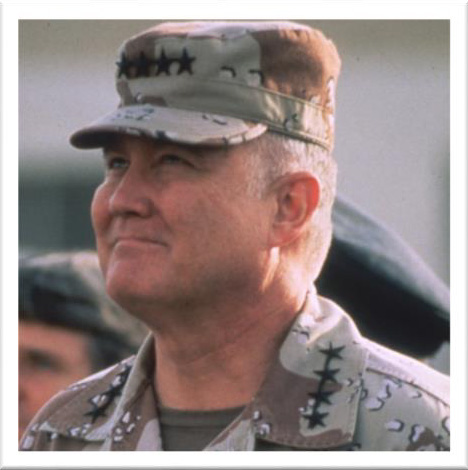 On August 22, 1934, Norman Schwarzkopf was born the son of a brigadier general in Trenton, New Jersey. Schwarzkopf graduated from West Point and fought in the Vietnam War. In 1983, he was made a major general and several years later became a four-star general and commander of the U.S. Central Command. His career included commanding forces in Grenada and the Persian Gulf War. He died in Florida in December 2012.
Early Life
Nicknamed “Stormin’ Norman,” General H. Norman Schwarzkopf was known for his fiery temper and his keen strategic mind. He grew up in Lawrenceville, New Jersey, with his two older sisters, Ruth Ann and Sally. Their father was Colonel H. Norman Schwarzkopf, who served in World War I and founded the New Jersey State Police. His father worked on the infamous kidnapping of Charles Lindbergh’s son in 1936 and later served in World War II. After the war, Schwarzkopf and his family accompanied his father to Iran for work. He went to school there and later in Geneva, Switzerland. Schwarzkopf then attended the Valley Forge Military Academy.
Schwarzkopf went to the famed military academy at West Point where he played on the football and wrestling teams. He was also a member of the chapel choir. After graduating in 1956 with a degree in engineering, Schwarzkopf later earned a master’s degree in the subject from the University of Southern California.
Military Career
Schwarzkopf volunteered to fight in the Vietnam War in 1966. During the war, he earned several honors for his service there, including three Silver Stars, a Bronze Star and a Purple Heart. Schwarzkopf had served as a battalion commander during the war. Plagued by a cracked vertebra, he underwent back surgery at theWalter Reed National Military Medical Center in 1971. Schwarzkopf then attended the U.S. Army War College the following year.
After the Vietnam War ended, Schwarzkopf stayed in the military and continued to rise up the ranks. He became a general in the late 1970s and served as the deputy commander of the U.S. forces during the 1983 invasion of Grenada. Five years later, he was called to lead the U.S. Central Command. He became one of the prominent figures in the military response to Iraq’s invasion of neighboring Kuwait in 1990.
In 1991, Schwarzkopf led Operation Desert Storm, the U.S. military effort to liberate Kuwait. He and his troops managed to drive outSaddam Hussein’s forces in only six weeks. During the war, Schwarzkopf became famous for his straightforward style and his short temper. He received numerous honors for his handling of this military conflict, including a knighthood from Queen Elizabeth II.
Schwarzkopf retired from military service in 1991. He shared his life experiences in his autobiography, It Doesn’t Take a Hero, which was published the following year. His memoirs were a hit with readers, and the book became a nonfiction best-seller.
Final Years
In retirement, Schwarzkopf served as a military analyst for NBC. He also worked as a public speaker, giving lectures around the country.
Some speculated that the popular general might make a bid for public office, but he chose to focus on other interests instead. Schwarzkopf supported a number of charities, including children’s organizations. He also worked for the conservation of grizzly bears and campaigned to raise awareness about prostate cancer.
Schwarzkopf didn’t stay away from military matters completely, however.
In 2003, the retired four-star general spoke out against the invasion of Iraq under President George W. Bush. He felt that the potential outcomes of the military action had not been fully considered. “What is postwar Iraq going to look like, with the Kurds and the Sunnis and the Shiites? That’s a huge question, to my mind. It really should be part of the overall campaign plan,” he said, according to the Associated Press.
Norman Schwarzkopf died on December 27, 2012, at his home in Tampa, Florida. Former president George H.W. Bush remembered him as “a true American patriot and one of the great military leaders of his generation,” adding “Schwarzkopf, to me, epitomized the ‘duty, service, country’ creed that has defended our freedom and seen this great nation through our most trying international crises. More than that, he was a good and decent man, and a dear friend.” Schwarzkopf was survived by his wife Brenda and their three children.
